My Yandere Childhood Friend Won't Let Me Be Average - Chapter 5

Chapter 5: My Grandfather Left Me a Girl, and I Do Not Know Her Name
Breakfast was the worst meal of my life.
My mother did not react.
That was the worst part. A cat girl, wrapped in a blanket that barely counted as a cloak, walked into the kitchen holding my sleeve the way a child holds a parent’s hand at a market. My mother looked up from the stove, smiled, and said, “Oh, how lovely, sit her by the window, the light is nice there.” Then she slid another plate onto the table.
There was another plate. She had already set the table for four.
“Mother.”
“Eat your eggs, Alfred.”
“Mother, why did you set the table for four?”
“Because there are four of us, darling.”
“There have been three of us for eighteen years.”
“And now there are four.”
“Mother, you knew.”
“I suspected, darling. Eat your eggs.”
I ate my eggs.
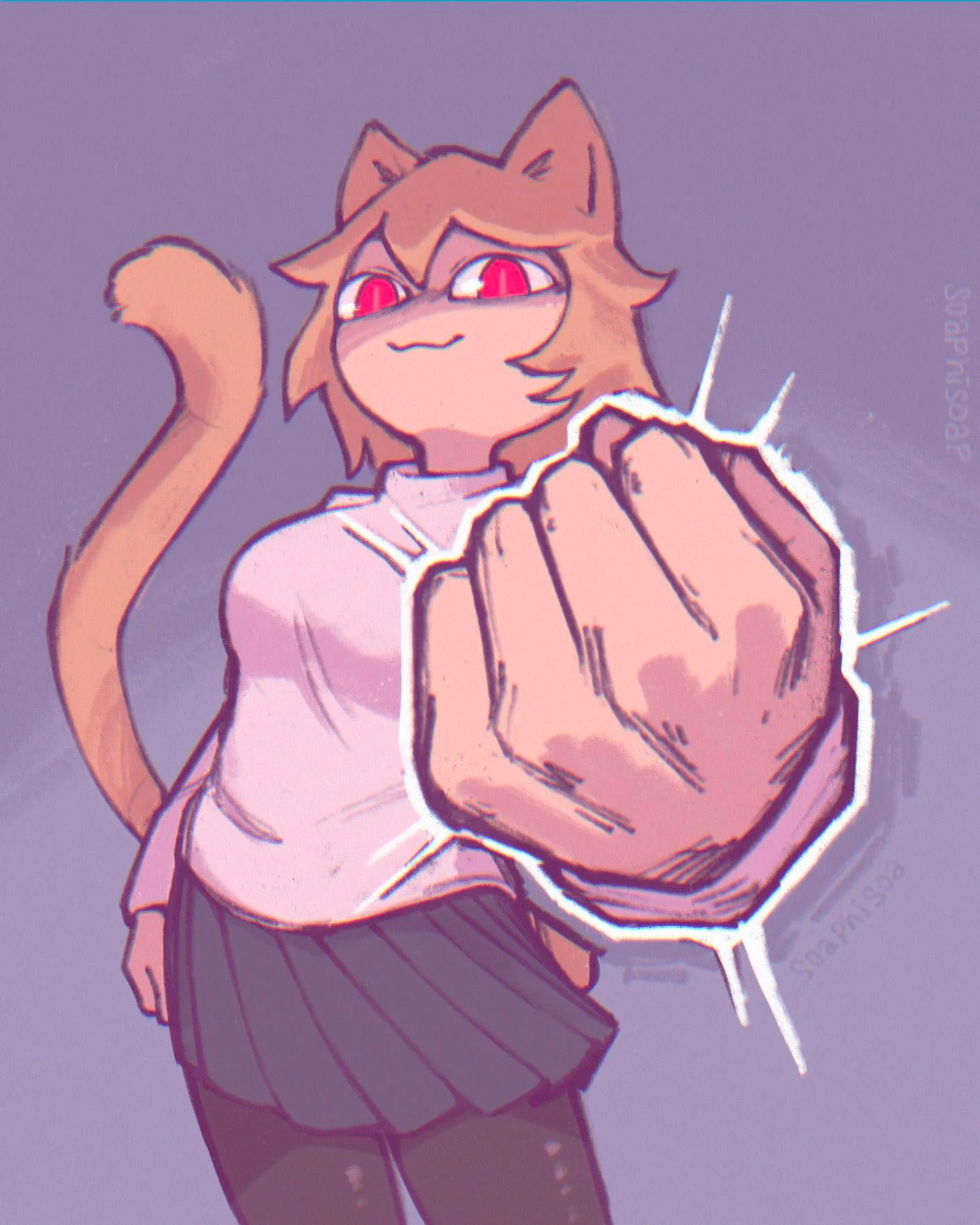
The cat girl sat carefully in the chair my mother pulled out for her. She sat like someone who hadn’t used a chair in a long time and was trying to remember how to bend her knees. Her tail slipped through the slats in the back. Her ears tracked every sound in the room. When my mother set a plate in front of her, she looked at it, then at me, and waited.
“…you can eat.”
She ate like someone who was very hungry but trying to be polite—using both hands, eating quickly, and doing her best not to show it. My mother watched her with a gentle but knowing smile, like someone who had just gained a new daughter and hadn’t told anyone yet.
My father stayed silent through the whole meal. He drank his tea and buttered his bread. Whenever I looked at him, the corner of his mouth twitched. Whenever I tried to speak to him, he picked up his cup to hide behind it. By the end of breakfast, he had finished four cups of tea, and I felt like I had aged six years.
The carriage came at the seventh bell.
It was a very fine carriage. Too fine. The wood was dark and polished, with the king’s sigil painted small and neat on the door. Four horses, black as wet coal, pulled it. The driver wore royal livery, and two guards in chain mail rode on either side. This wasn’t a student coach. This was an escort, the kind sent for someone important or someone who might be taken.
I did not like either possibility.
My mother cried, once, quickly, into her apron. My father clapped me on the shoulder hard enough to leave a bruise and said, “Write to us. Not too often. A man should not write to his parents too often. Once a month. More if you get married.”
“I am not getting married.”
“Once every two months, then.”
“FATHER.”
He helped me carry the bag to the carriage. The cat girl followed a step behind me the whole way, silent. She hadn’t spoken since that one word in the yard. My mother had found her a proper traveling cloak from somewhere, deep green and hooded, lined with soft wool. She wrapped it around her shoulders and pinned it at the throat with a silver clasp shaped like a leaf. Now, she looked almost ordinary.
Ordinary except for the ears.
Ordinary except for the tail.
Ordinary, except for how she stayed close to me, like a candle always stays close to its wick.
The driver opened the carriage door. I handed her up first because my mother was watching, and my mother has opinions about manners. The cat girl made a small, surprised sound when my fingers touched hers. She looked at our hands. She looked at my face. Her ears went flat for half a second and then perked up again, and she climbed into the carriage and slid all the way to the far side of the bench with her hands folded in her lap, waiting.
I got in. I sat across from her. The door shut. The carriage lurched.
We were moving.
I was in a royal carriage, on royal business, on my way to a royal academy of magic, with a girl my dead grandfather had left me in a scroll like a bottle of wine.
I put my face in my hands.
“…”
“…”
“…can you talk?”
She nodded.
“But you are not talking.”
She nodded again. Her ears went down a little. She looked at her hands. Her fingers curled around each other.
“You were waiting.”
Nod.
“For a long time.”
Nod.
“In the scroll.”
Nod.
“…how long?”
She held up one finger. Then she thought about it. She put her finger down. She held up both hands, fingers spread. Then she closed her hands and opened them again. Then she gave up and looked at me with a helpless little expression that said a while.
A while.
My grandfather died more than twenty years ago.
“…we are getting you food.”
Her ears came back up.
The carriage rolled through the city gate and onto the king’s road. The road was smooth and well-kept, as the king’s roads always are, and we picked up speed on the flat stones. Through the small window, I saw fields opening into the golden morning—farms, low stone walls, a boy herding cows, a woman hanging linen. Ordinary things. The kingdom ran on ordinary things. Only at the very top or bottom did things get strange.
I was, apparently, going to the top.
My cat girl was sitting across from me, watching the fields go by with the careful attention of someone who had not seen a field in twenty years. Her eyes were wide. Every time a bird flew past the window, her head turned to track it. Once, a rabbit bolted across the road ahead of the horses, and her whole body went still the way a cat’s body goes still, and then she caught herself, glanced at me, and folded her hands back in her lap and pretended she had not noticed the rabbit at all.
“You can look at the rabbits.”
She looked at me.
“It is allowed. Looking at rabbits is allowed.”
The smallest smile. The smallest, smallest smile. The corners of her mouth barely moved. Her ears flicked forward.
I had to look out my own window for a minute.
After a while, I cleared my throat.
“You don’t have a name.”
She shook her head.
“Grandpa didn’t give you one.”
She shook her head again. Her ears went down a little. She looked at her hands.
“…he really was an idiot.”
She made a small noise. It was not quite a laugh. It was the noise a person makes when they want to laugh but have not practiced laughing in a long time and are not sure if it is allowed. Her shoulders shook, once. Her ears came back up.
“Okay. Okay. We are fixing this. You need a name.”
She looked up. She looked at me very seriously. Her honey-colored eyes were enormous in the carriage light. She waited.
This, I realized, was a mistake.
I had never named a person before. When I was six, I named a toy sword Stabby. That was as far as my naming experience went. Now, a girl sent to me by my famous grandfather, kept in a scroll for twenty years, and sitting across from me in a royal carriage with the most serious face, was waiting for a name.
“…Nyxie.”
Her ears went down.
“No. No, not Nyxie. Forget Nyxie. Nyxie did not happen.”
Her ears came back up, a little uncertain.
“Okay. Think. Think, Alfred. Think like a normal person. Something soft. Something kind. Something that suits her.”
Her tail gave one slow swish behind her.
“Rin.”
Her ears twitched.
“Rin?”
The ears went up. All the way up. Her eyes got, impossibly, a little wider. Her mouth opened just slightly. She touched her own chest with the tips of her fingers.
“Rin.”
“Do you like it?”
She nodded. Fast. Her hair bounced.
“Say it again.”
“Rin.”
“Louder.”
“Rin!”
She covered her mouth with one small hand, surprised by the sound of her own voice. Then she laughed—a real laugh this time, small, rough, and surprised, like someone who had just remembered how to laugh. Her tail flicked happily against the bench.
I had to look out the window again.
I am not a soft man. I am a lazy man. There is a difference. A lazy man is just tired. A soft man is the one in trouble.
I was, at that exact moment, in trouble.
The carriage climbed.
You could feel it in the tilt of the floor. The horses slowed to a steady pull. I leaned toward the window. The king’s road climbed into the foothills, the fields falling away behind us. Ahead, above us now, a long white wall rose out of the green.
The Academy.
It sat on a plateau like a crown on a head. White stone, blue roofs, and three towers—smaller and friendlier than the one on the north hill of my city—stood at the corners of a large square courtyard. Banners snapped in the wind, showing the king’s crest, the Academy’s crest, and below them, the smaller symbols of the kingdom’s ten great houses. The gate was huge, made of gilded wrought iron, and stood open. A line of students was coming in from the other road, the common road, the one for people not brought in royal carriages. They carried their own bags and had come by foot, cart, or cheaper coaches.
Nobody had come the way I was coming.
The outriders fell back to flank the carriage. The driver called the horses. The carriage slowed. The Academy gate widened in the window, closer, closer, and I could see the guards at the arch straighten as they saw the king’s sigil on the door.
Rin leaned forward. Her hood slipped back a little. Her ears pushed out of her hair.
Her eyes went huge.
“Big.”
“Yeah.”
“Alfred.”
She had not said my name before.
She said it carefully, like someone trying on a new pair of shoes. She looked at me as she spoke. Her ears were up and her hands folded in her lap. For a moment, she seemed less like a girl my grandfather had left me in a scroll and more like a real person who had just arrived somewhere new and didn’t know what would happen next.
I looked back at her.
“Yeah.”
“Stay with me.”
“Yeah, Rin.”
“Promise.”
“…I promise.”
The carriage rolled through the gate.
The Academy swallowed us.
Somewhere above the courtyard, the wind shifted. It swept down from the high towers into the square, carrying a faint scent of fresh paper, polished stone, and old magic. It was the smell of a place where things were about to begin.
I took a breath.
I took another.
I stepped down from the carriage with one hand held out behind me, and a small warm hand caught mine without hesitation, and Rin stepped down beside me onto the white stones of the Royal Academy of Magic, and her tail, under her cloak, gave one slow, certain flick.
Far to the north, on a hill in a city I had left behind me at dawn, a girl in a white tower was standing at her window.
She was smiling.

Comments for chapter "Chapter 5"
YOU MAY ALSO LIKE